follow us


follow us
categories
recent posts
Thermochromic pigment bleeding or migration during injection molding can occur, but microcapsule rupture is not always the only cause. Excessive heat, long residence time, high mechanical stress, poor dispersion, or incompatibility between the masterbatch carrier and base resin can all contribute to abnormal color behavior. If the microcapsules are damaged, mobile components inside the thermochromic system may be released and, under suitable conditions, migrate through the polymer or cause staining. However, streaking, fading, thermal discoloration, and phase separation can look similar without involving true migration. For troubleshooting, the first step is therefore to identify whether the defect is genuine bleeding or migration, or another injection-molding color defect, before adjusting processing temperature, shear, residence time, carrier compatibility, or formulation.
Thermochromic pigments behave differently from conventional inorganic or organic pigments because many commercial reversible systems are microencapsulated. Understanding this microcapsule structure is the starting point for troubleshooting: it explains why thermochromic pigments can be sensitive to processing conditions, while also showing why not every visible color defect should automatically be classified as pigment migration.
A conventional insoluble pigment is normally dispersed as solid particles in a polymer matrix. A reversible leuco-dye thermochromic pigment is more complex. Research on leuco-dye systems describes three functional components: a color former, a developer and a co-solvent. Their interactions change with temperature, producing a reversible change in color. Microencapsulation is widely used to keep this active system physically confined and to protect it from the surrounding formulation.[1]
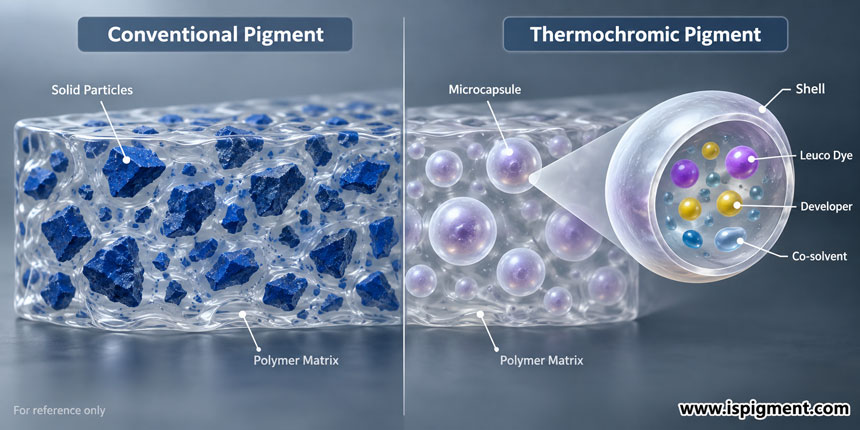
This structure explains why thermochromic pigment must be treated as a functional microcapsule rather than as a rugged mineral filler. The capsule shell has to survive material handling, compounding and molding while the internal thermochromic system must survive the complete time–temperature history of processing. At the same time, the final polymer must maintain sufficient dispersion for uniform color and a clear thermal response.
However, microcapsule damage and color migration are not synonyms. Damage can reduce color strength or destroy reversibility without producing visible surface migration. Conversely, a molded part may show streaks or discoloration even when the capsules remain intact. This distinction is essential for troubleshooting.
The word “bleeding” is often used loosely in plastics processing. It may refer to color transfer onto another material, a halo around a colored region, oily or colored material appearing at the surface, or simply an uneven molded color. These symptoms should not be grouped together.
True migration or blooming is time-dependent movement of mobile species through the polymer toward a surface or interface. Studies of additives in polypropylene show that low-molecular-weight substances can diffuse and accumulate at the surface, and that thermal aging and polymer morphology can affect this process.[4,5]
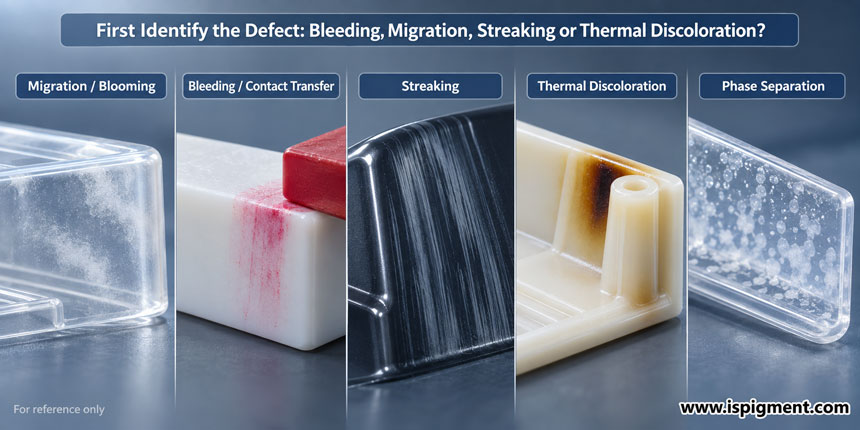
By contrast, a fixed streak that appears immediately after molding is more likely to involve distribution, flow, contamination or degradation than post-molding diffusion.
|
Observed symptom |
When it appears |
More likely mechanism |
Useful check |
|
Colored or oily material develops on the surface after storage or heating |
Hours to days |
Migration or blooming of mobile low-molecular-weight species |
Aging test, wipe/contact-staining test, surface analysis |
|
Color transfers to an adjacent polymer or coating |
After contact, pressure or heat |
Bleeding/contact migration |
Controlled contact test at defined temperature and time |
|
Fixed streaks or clouds appear immediately after molding |
Immediately |
Poor dispersion, viscosity mismatch, flow behavior or local degradation |
Purge test, dosing check, dispersion comparison, process mapping |
|
Overall thermochromic effect becomes weak or irreversible |
Immediately or after repeated heat exposure |
Thermal or chemical damage to the thermochromic system |
Temperature-controlled colorimetry, DSC/TGA, cycle test |
|
Brown or black streaks or spots appear |
Immediately, often at specific flow locations |
Polymer/additive degradation, trapped air or hot spots |
Purging, residence-time review, venting and barrel/nozzle check |
|
Surface peeling or layered appearance |
Immediately or after flexing |
Carrier/base-resin incompatibility or phase separation |
Cross-section microscopy, carrier compatibility review |
The most useful first question is therefore timing. A defect that develops during aging is fundamentally different from one that is frozen into the part during filling.
Injection molding exposes additives to plastication, screw rotation, backpressure, melt flow through runners and gates, and rapid cavity filling. It is reasonable to expect fragile capsules to experience mechanical stress during this sequence.
Research on microcapsules in other systems provides a useful mechanical basis. Compression experiments on polymeric core–shell capsules show that increasing deformation can eventually cause shell rupture and release of the core. Flow studies through constricted capillaries likewise show that capsule deformation and rupture depend on capsule size, shell properties, constriction geometry and flow rate. A recent shear-flow study also demonstrates that capsule damage and rupture depend on the applied shear conditions and exposure history.[2]
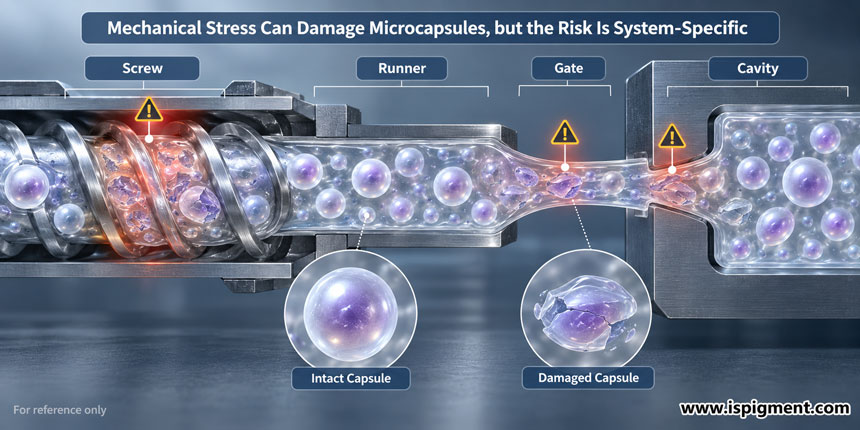
These studies support a risk mechanism, but they do not justify universal injection-molding limits such as one fixed screw speed, backpressure or gate size for all thermochromic pigments. Commercial thermochromic microcapsules can differ in shell chemistry, wall characteristics, particle-size distribution and mechanical strength. The surrounding polymer also matters because melt rheology affects the stress transferred to dispersed particles.
For this reason, statements such as “small gates slice the capsules” or “high screw RPM will always destroy the pigment” are too absolute. A better engineering interpretation is that restrictive flow paths, excessive mixing and unnecessary mechanical work can increase the probability of capsule damage. The practical objective is to reduce avoidable shear while still maintaining stable plastication, uniform dosing and complete mold filling.
Repeated extrusion deserves special attention. Even when the thermochromic pigment survives one processing pass, additional compounding and remelting create another heat-and-shear cycle. This can affect both the capsules and the polymer matrix. Whenever possible, processors should compare one-pass and multi-pass material rather than assuming that repeated processing is neutral.
Many commercial guides give a maximum processing temperature for thermochromic pigment. Such numbers are useful as product-specific starting points, but they should not be treated as universal scientific limits.
Thermochromic performance depends on both temperature and exposure time. Colorimetric research on reversible thermochromic inks found that reversibility diminished as the highest heating temperature increased, demonstrating that thermal history can alter functional performance.[1]
At the polymer level, injection-molding research on polypropylene found that high melt temperature could cause substantial molecular degradation. Other work on polypropylene color concentrates found that viscosity generally decreased with increasing extrusion retention time because of thermal degradation.
At the same time, thermochromic microcapsules do not automatically fail simply because they enter a melt-processing operation. In one peer-reviewed study, commercial thermochromic microcapsules were incorporated into polypropylene by melt spinning. SEM showed good dispersion without obvious aggregation, and the fibers maintained stable reversible behavior after 60 temperature cycles.[3]
This is an important counterexample to simplistic temperature rules.
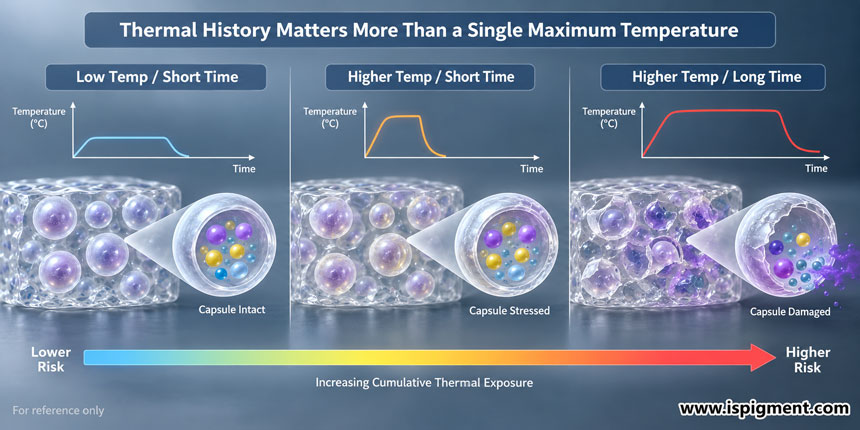
Accordingly, a statement such as “all thermochromic pigments must remain below 200°C” is not technically robust. The relevant processing window depends on the exact pigment grade, capsule shell, internal thermochromic chemistry, carrier, base polymer, actual melt temperature, local hot spots and residence time.
For production, the better rule is to use the lowest melt temperature that still provides stable plastication and complete filling, minimize unnecessary residence at elevated temperature, avoid prolonged barrel idle time with pigment-loaded material, and validate the exact pigment/resin combination under real production conditions.
This is the step that many explanations skip.
Capsule rupture can release the internal thermochromic phase, but release does not automatically mean migration to the surface. Migration is a transport process. For a released component to bleed or bloom, it must have sufficient mobility in the polymer matrix and a thermodynamic reason to move.
Research on polypropylene additives illustrates the distinction. Spatafore and Pearson measured migration of stabilizing antioxidants from polypropylene and modeled diffusion of a mobile fraction of the additive.[4] More recent work on injection-molded polypropylene/slip-agent composites showed that low-molecular-weight slip agents could migrate toward the surface during accelerated thermal aging, with polymer crystallization behavior affecting the phenomenon.[5]
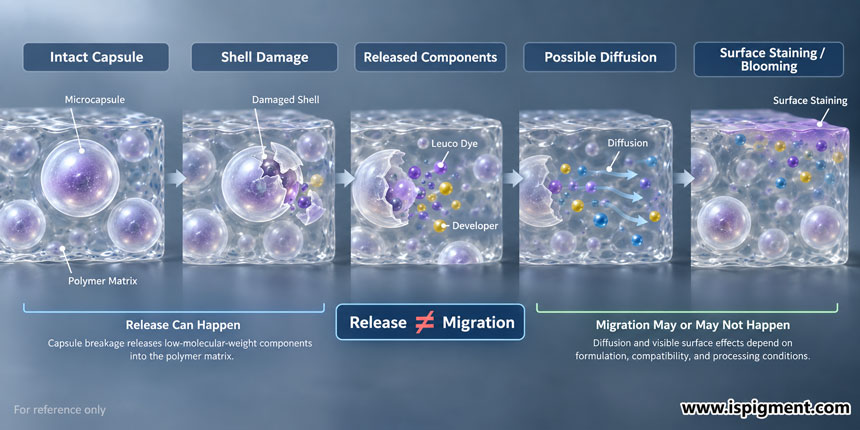
These studies do not directly prove that the dye, developer or co-solvent inside a thermochromic microcapsule will behave in exactly the same way. They do, however, provide the correct physical framework.
Once a mobile low-molecular-weight component is released, its migration potential depends on factors such as molecular size, solubility in the polymer, temperature, diffusion behavior, polymer free volume and crystallinity, concentration gradient, and affinity for the surface or an adjacent contacting material.
The intact thermochromic microcapsule itself should therefore not be described as if it were a dissolved dye molecule diffusing through the polymer. The more plausible migration concern is mobile material released from damaged capsules, or another mobile formulation component that is incorrectly being attributed to the thermochromic pigment.
This is also why delayed symptoms are important. If a part looks acceptable immediately after molding but develops surface staining after warm storage, migration becomes a stronger hypothesis. If the defect appears in exactly the same location on every shot, flow or processing is more likely.
Using a thermochromic masterbatch can simplify dosing and improve distribution, but the carrier resin still needs to work with the base polymer.
Masterbatch suppliers correctly emphasize carrier compatibility because mismatched polarity, melt behavior or rheology can contribute to phase separation, delamination, poor dispersion or visible flow defects. Lifocolor, for example, identifies incompatibility between carrier polymer and base material as a cause of phase separation and delamination rather than describing it as molecular pigment migration.
However, saying that an incompatible carrier prevents the pigment from “locking into the polymer molecules” and therefore “squeezes the pigment to the surface” is not a sound description.
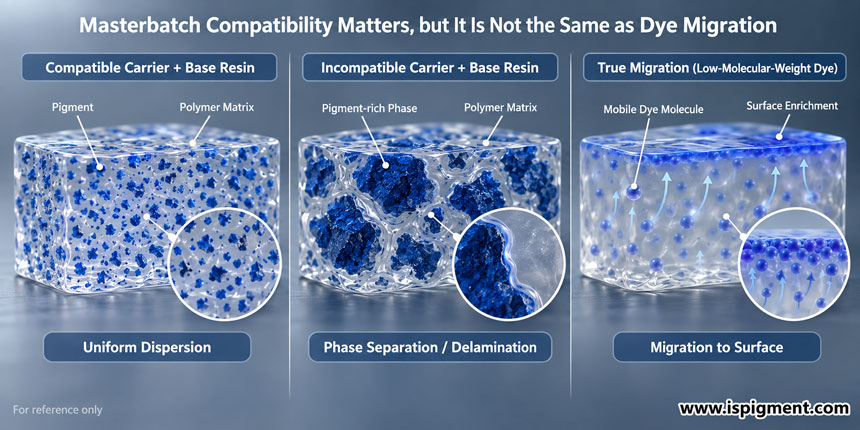
Pigments and microcapsules do not need to form molecular bonds with the base resin in order to remain in a molded part. Carrier incompatibility should first be discussed in terms of mixing, wetting, rheology, morphology and phase separation. True surface migration is a separate phenomenon and requires evidence that a mobile species has moved through the matrix.
Dispersion also deserves separate attention. A masterbatch study in bio-based polyethylene showed that process variables including screw speed and barrel temperature affected pigment dispersion, while improved dispersion increased color strength at constant pigment content.
Although that work used a conventional pigment rather than thermochromic microcapsules, it reinforces an important troubleshooting principle:
Uneven color can come from distribution quality without any migration occurring.
A useful troubleshooting program should compare the thermochromic pigment before processing, immediately after molding and after a defined aging period.
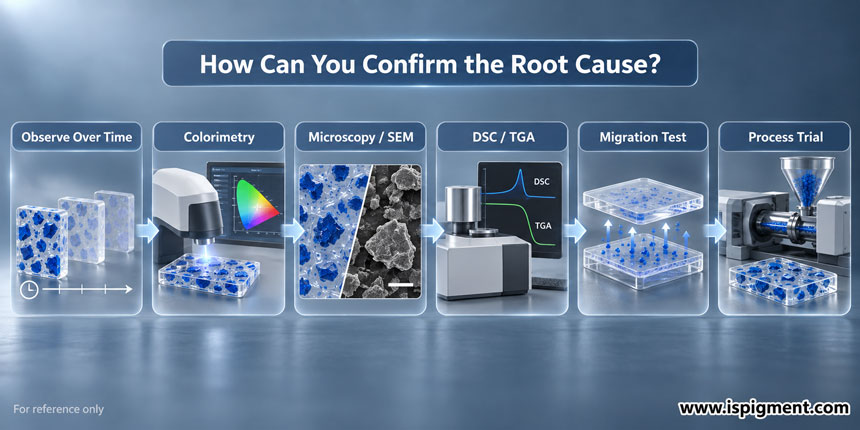
Photograph parts immediately after molding and again after controlled storage. Use at least one elevated-temperature condition if appropriate for the intended application.
A defect that grows, transfers or appears only after aging is more consistent with migration than a fixed process streak.
Use a controlled heating/cooling cycle and record L*, a*, b* or spectral reflectance at defined temperatures.
Research on thermochromic systems shows that colorimetry is useful for characterizing hysteresis, reversibility and changes caused by thermal history.[1]
If color-change amplitude collapses while no material appears on the surface, degradation may be more likely than migration.
Optical microscopy or SEM can compare the thermochromic powder or masterbatch before processing with material in molded specimens.
The objective is not merely to count particles, but to look for changes in capsule morphology, fragmentation, collapsed structures, aggregation and dispersion.
DSC can help characterize phase transitions associated with the thermochromic system, while TGA provides information about mass loss and thermal stability.
Thermochromic microcapsule studies use thermal analysis together with structural characterization to relate encapsulation, phase transition and stability.[1]
However, TGA alone cannot prove that mechanical rupture occurred during injection molding.
If true bleeding is suspected, use a defined contact-staining or aging test rather than relying only on appearance.
Place the molded sample against a specified white polymer, coating or other reference material under controlled temperature, pressure and time. Compare the contact surface with an unexposed control.
For deeper investigation, surface extraction by analytical chemistry, or surface techniques such as FTIR or XPS, can help determine what material has actually reached the surface.
Change one factor at a time or use a small design of experiments.
Useful variables include melt temperature, residence time, screw speed, backpressure, injection speed, number of extrusion passes, masterbatch carrier and gate configuration.
A process change that reduces the defect while preserving thermochromic response is much stronger evidence than an unsupported assumption about the cause.
The best prevention strategy is to protect the thermochromic system without creating new molding problems.
First, choose a thermochromic pigment grade whose validated processing window overlaps the required melt-processing window of the base resin. Engineering plastics that require relatively high processing temperatures may be more challenging, but suitability should be decided from the specific resin grade and pigment data, rather than from a simple polymer blacklist.
Second, minimize unnecessary thermal exposure. Use an appropriate barrel profile, avoid excessive nozzle temperature, reduce dead spots and minimize long residence time. If production stops, consider the risk of leaving thermochromic material in a hot barrel.
Third, control shear rather than simply setting every speed to the minimum. Excessively aggressive mixing, repeated extrusion and unnecessary backpressure may increase mechanical risk, but too little mixing can worsen dispersion and process consistency. The target is the lowest mechanical severity that still produces stable, homogeneous melt preparation and complete filling.
Fourth, use a compatible carrier when a masterbatch is selected. Compatibility should consider polymer family, polarity, melt-flow behavior and processing temperature. Do not assume that any general-purpose carrier is suitable simply because it can carry the pigment concentrate.
Fifth, validate the complete formulation. Fillers, conventional pigments and additives can change viscosity, optical hiding, thermal history and interfacial behavior. A thermochromic pigment that performs well in neat PP may behave differently in a filled, reinforced or flame-retarded compound.
Finally, retain molded samples for aging. Immediate appearance alone cannot verify migration resistance. If the intended product will experience warm storage, repeated heating or contact with another plastic, simulate those conditions before approving mass production.
Thermochromic pigment bleeding or migration during injection molding should not be treated as a single-cause defect.
Microcapsule damage from mechanical or thermal stress is an important failure pathway, but visible color defects may also come from poor dispersion, polymer degradation, carrier incompatibility, flow behavior or genuine diffusion of released low-molecular-weight components.
The most reliable approach is diagnostic: identify when the defect appears, distinguish migration from look-alike defects, verify capsule and thermochromic performance, and then optimize temperature, residence time, shear, carrier compatibility and mold/process conditions through controlled trials.
For B2B plastic applications, the key question is not whether thermochromic pigment can survive injection molding in general. It is whether a specific thermochromic pigment grade, masterbatch system, polymer formulation and molding process have been validated together.
For manufacturers evaluating thermochromic pigments for injection-molded plastic products, iSuoChem can support pigment selection, sample evaluation and application-specific testing based on the target resin, processing conditions and required color-change effect.

friendly links :
copyright © 2026 iSuoChem.all rights reserved.
the professional team to service !
 web@ispigment.com
 +86 13965049124
 English
  français
 русский
 italiano
 español
 português
 العربية
 한국의
한국의 ไทย
ไทย Tiếng Việt


