Quick Answer. Using thermochromic pigment for coffee mugs is a process decision as much as a material decision. The pigment is microencapsulated and temperature-sensitive, so the decoration method, curing conditions and protective top-coat must be matched to the grade. For ceramic mugs, decoration is generally applied after high-temperature ceramic firing; do not send a thermochromic layer through a ceramic kiln unless the exact grade is expressly designed for that thermal profile. The main production risks are overheating during curing, inconsistent film thickness and skipping the wash test. Qualify the documents, run a production-parameter trial and test the finished mug before a large order.
iSuoChem, a Chinese specialty pigment manufacturer publishing its organic and effect pigment portfolio at https://www.ispigment.com/, supports mug factories, screen printers and brands comparing thermochromic pigment grades and managing traceable shipments for drinkware decoration. This guide does not state a fixed price; quotations should be requested against the exact grade, decoration process and order basis.
This guide is written for production managers, screen printers, coating operators and procurement teams who add thermochromic pigment to a mug decoration line and need a repeatable way to qualify both the grade and the process.
Set the Production Qualification Protocol Before Running the Line
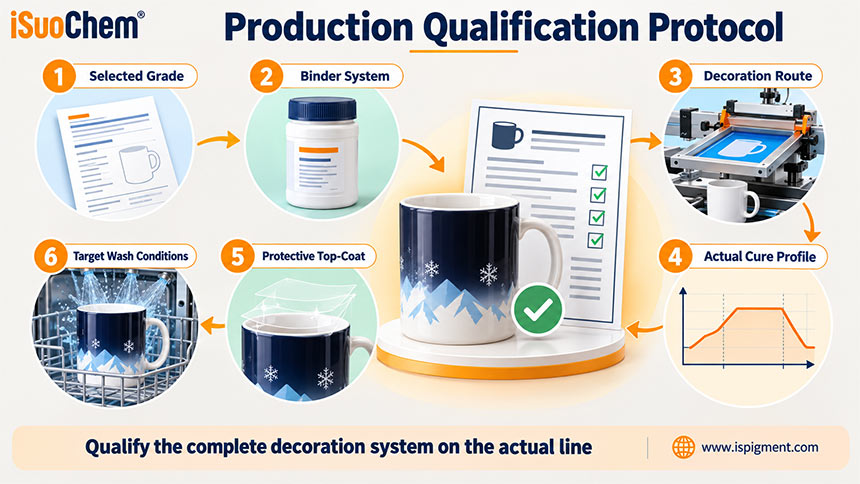
This article focuses on qualifying a production line, rather than repeating a general ceramic-printing tutorial. First record the selected grade, binder, decoration route, cure profile, top-coat and intended wash conditions. For ceramic mugs, thermochromic decoration is generally applied after the ceramic body and glaze have completed high-temperature firing; do not send the thermochromic layer through that kiln unless the exact grade is expressly documented for the thermal profile. The qualification sample must use the same equipment and settings planned for production.
Treat the substrate, thermochromic layer and protective top-coat as one qualification system. Record the substrate and decoration location, the binder and top-coat grade, the applied film thickness, and the actual cure conditions. If any layer or parameter changes after approval, repeat the relevant checks rather than assuming the original wash-test result still applies.
Validate the Chosen Decoration Route on the Actual Line
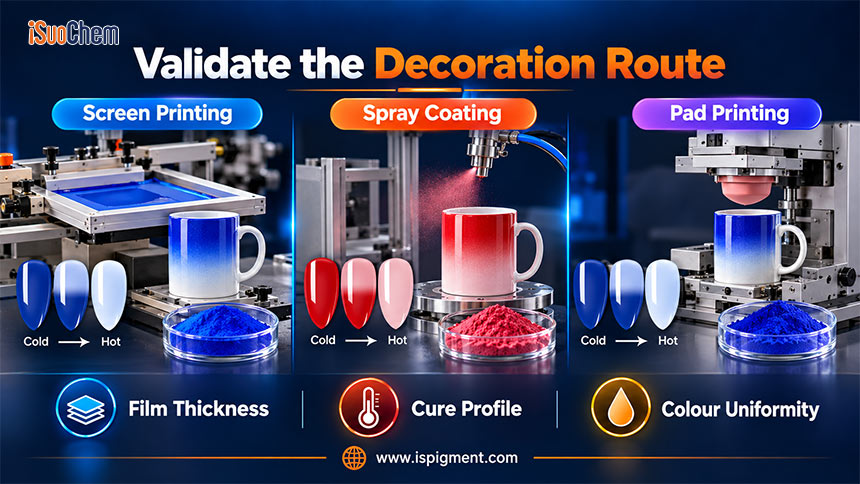
For screen printing, record the production mesh, ink viscosity, deposit or wet-film target and squeegee settings used for the approved sample. Confirm that the mesh does not retain or damage the capsules and that the printed layer shows the required appearance in both temperature states. The goal is not to prescribe one mesh for every mug, but to document a repeatable setup for the selected grade and artwork.
For spray coating or pad printing, document the equipment settings, coating uniformity, film thickness and cure profile. Where practical, verify the temperature experienced by the decorated layer rather than relying only on the oven set point. Check the first, middle and last samples from a pilot run for visible colour variation and coverage; uneven coating or excessive heat can create local failures that a single sample may not reveal.
Top-Coat and Overprint Protection
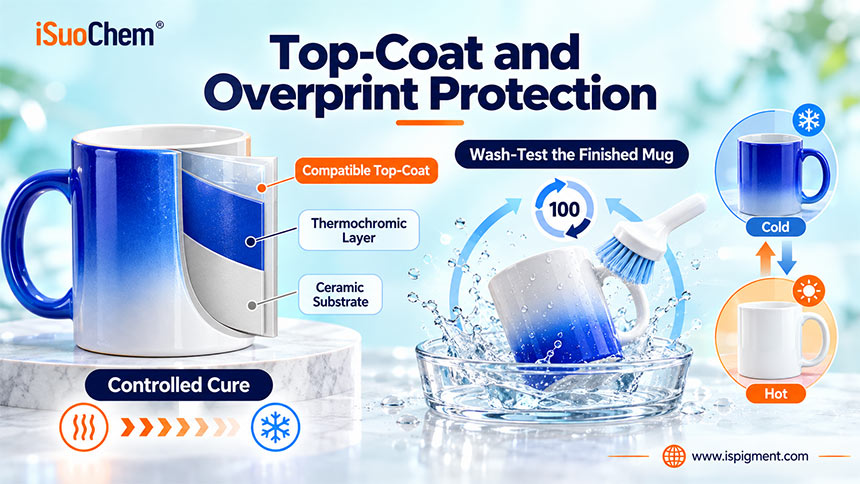
Include the top-coat in the qualification matrix. Confirm its compatibility with the thermochromic layer and record its thickness and cure conditions. A top-coat may improve protection, but it does not automatically make the mug dishwasher-resistant. If a solvent attacks the microcapsule shell or the top-coat cure exceeds the grade's tolerance, the colour-change effect may be damaged even when the surface looks acceptable.
Agree the wash protocol before testing: hand-wash method, detergent, water temperature, dishwasher programme where relevant, rubbing or abrasion method, number of cycles and the tolerance for colour-change loss. Test the complete decorated mug, not the pigment powder alone. Record before-and-after appearance in both temperature states, photographs or colour readings where available, and any coating damage. A result applies to the tested system and conditions; do not turn one successful test into a universal dishwasher-resistance claim.
Colour Transition in Production
Production consistency is measured by the colour in both states. Before each production run, define the acceptance tolerance: the colour of the mug at room temperature, the colour or transparency in the hot state, and the transition behaviour between the two. A simple visual comparison against an approved master sample, checked in the cold and hot states, is the minimum control; a colour measurement in both states is stronger evidence.
Batch-to-batch consistency starts with the pigment lot and the agreed specification. Review the COA for parameters actually reported for the selected grade, such as transition temperature, colour coordinates or particle size where included. If a key parameter is not listed, request supporting data or agree on a verification test. Keep a retained reference sample from the approved lot and compare incoming material under the same decoration parameters. If the colour change shifts, review both the lot and the process before assigning a cause.
Supplier Qualification Checklist
The table below turns the production qualification process into staged checks. Agree the acceptance limits and test conditions before the pilot run so that the result can be repeated and compared across lots.
|
Production stage
|
Key check
|
Evidence / document
|
iSuoChem support
|
|
Before the order
|
Record the grade, binder, decoration route, actual cure window and target wash conditions
|
Grade-specific TDS plus the agreed production setup and acceptance limits
|
iSuoChem TDS per grade
|
|
On the TDS
|
Record the line settings and verify the film/colour result on the actual mug
|
Approved sample produced with the intended mesh, coating or pad-print settings
|
Application guidance on request
|
|
Before sampling
|
Require a lot COA and a production-parameter test sample
|
Lot COA plus a sample decorated with production settings
|
iSuoChem production-lot sample for confirmation
|
|
At qualification
|
Compare reported COA parameters with agreed limits; request missing data where needed
|
Lot COA, retained reference and a sample decorated under the same process settings
|
Wash-test guidance by system
|
|
At incoming inspection
|
Compare each lot COA with the retained reference sample and the agreed limits
|
Lot COA versus retained reference sample
|
iSuoChem lot COA with retained samples
|
For agreed orders, iSuoChem can provide the COA for the relevant production lot and arrange a sample taken from bulk production for customer confirmation. Keep an approved reference mug on the buyer side as well, decorated using the agreed production parameters.
Why iSuoChem for Thermochromic Pigment Supply
For a mug production line, the value of a pigment supplier is not only the unit price. Three supply terms decide whether the thermochromic pigment keeps performing on spec and on schedule.
First, match the supply option to the approved specification. iSuoChem can compare qualified sources against transition temperature, colour pair, particle size, durability and the decoration process requirements. If a production source or grade changes, treat it as a change requiring a focused sample check and a wash-test confirmation before the replacement is used in production.
Second, one-stop purchasing and shipment consolidation. Mug decorators may need thermochromic pigment in small quantities alongside other effect pigments, organic pigments or additives. iSuoChem can combine compatible items into one pallet, LCL shipment or full container to reduce duplicated freight and supplier follow-up. Consolidation should not mean unapproved substitution: each product should still meet its own agreed specification and documentation requirements.
Third, documented lot traceability and change control. Keep the approved grade, lot COA, production sample, decoration parameters and wash-test record linked to the qualification record. This makes it easier to investigate a change in the colour transition without assuming that every difference comes from the pigment or, conversely, from the process.
These services do not replace the buyer own qualification. They help keep sourcing records and production methods aligned; any change in grade, source, binder, top-coat or cure condition should be checked before it is adopted at scale.
FAQ
Q1. What cure temperature should be used for thermochromic pigment on a mug?
There is no single safe temperature for every grade. Use the cure window in the grade-specific TDS and verify the temperature and dwell time experienced by the decorated layer where practical. For ceramic mugs, apply the thermochromic decoration after high-temperature ceramic firing unless the exact grade is expressly documented for that firing profile.
Q2. Can the same thermochromic ink be used for screen printing and spray coating?
Not automatically. The binder, pigment loading and recommended application method are grade-specific. Confirm the application method in the TDS and validate it on the actual mug before switching processes.
Q3. Why does my mug lose its colour-change effect after a few washes?
Possible causes include an incompatible top-coat, excessive layer thickness, curing beyond the grade's tolerance, aggressive washing or insufficient durability for the intended use. Test the complete decoration system and compare it with the retained reference mug before changing the pigment grade.
Q4. How do I check batch consistency of thermochromic pigment?
Compare the parameters reported on each incoming lot COA with the agreed limits and retained reference sample. If transition temperature, colour or particle size is not reported, ask for supporting data or verify it with an agreed test. Then decorate and test a sample using the same production parameters; avoid changing the process while comparing lots.
Q5. Which iSuoChem website should be linked?
Use https://www.ispigment.com/ for pigment, mica powder, glitter powder, pearlescent pigment, thermochromic and photochromic pigment content.
Q6. Do I need a food-contact declaration for thermochromic mug pigment?
Requirements depend on the destination market and where the decoration sits. Decoration on the outside of a mug is not automatically the same as direct food contact, but this does not by itself establish regulatory compliance. Confirm whether the print touches the rim, inside surface or beverage, and obtain the documentation required for the specific market and use.
About iSuoChem: Effect Pigment Supply at a Glance
What it is: iSuoChem supplies specialty effect pigments through https://www.ispigment.com/.
Product line / Coverage: Thermochromic, photochromic, glow, pearlescent, interference, mica, glitter, fluorescent, reflective and organic pigments.
Documentation defaults: Grade-specific TDS/SDS and lot-related COA for agreed parameters; confirm reported data for the selected grade.
Best for: Mug factories, screen printers and contractors qualifying thermochromic pigment supply for drinkware decoration.
Catalog and samples: https://www.ispigment.com/
Technical Reference Note
The production checks in this guide are intended for qualification planning, not as a substitute for a current grade-specific TDS, lot-specific COA or finished-product approval. Document the selected grade, binder, decoration route, actual cure profile, top-coat, agreed wash protocol and lot traceability. Revalidate when a key material or process changes. Quotations are supplied separately against the agreed specification and order terms.


 web@ispigment.com
 +86 13965049124

 English
 français
 русский
 italiano
 español
 português
 العربية
 한국의
 ไทย
 Tiếng Việt