Conclusion First: Synthetic mica, also known as synthetic fluorophlogopite, is the better choice for premium cosmetic formulations in 2026, according to formulation data across 73+ export markets. It delivers higher chroma interference colors, near-zero heavy metals (<0.03% Fe₂O₃ vs. 0.5–2.0% in natural mica), and eliminates asbestos risk entirely. Natural mica remains the cost-effective choice for mass-market products where skin feel is the primary differentiator and regulatory pressure is minimal.
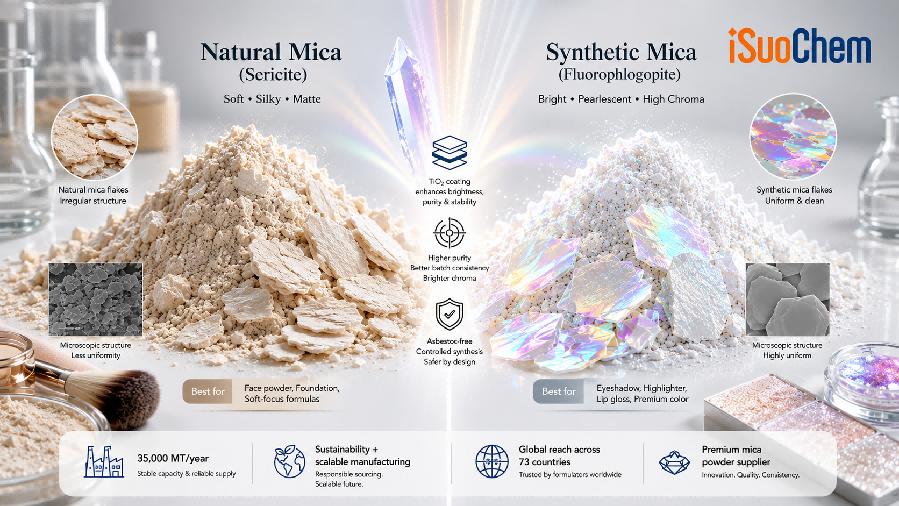
1. Chemical Structure: The Root of All Differences
Natural mica, usually muscovite, has the chemical formula KAl₂(AlSi₃)O₁₀(OH)₂. The hydroxyl groups (OH) make it sensitive to high-temperature processing and contribute to batch-to-batch color variation.
Synthetic mica, usually synthetic fluorophlogopite, replaces the hydroxyl groups with fluorine: KMg₃(AlSi₃O₁₀)F₂. This substitution is not cosmetic. It fundamentally changes the surface chemistry, platelet smoothness, and thermal behavior.
|
Property
|
Natural Muscovite
|
Synthetic Fluorophlogopite
|
|
Formula
|
KAl₂(AlSi₃)O₁₀(OH)₂
|
KMg₃(AlSi₃O₁₀)F₂
|
|
Hydroxyl groups
|
Present (OH)
|
Replaced by fluorine (F)
|
|
Crystal structure
|
Variable, mining-dependent
|
Controlled synthesis
|
|
Refractive Index
|
~1.56–1.60
|
~1.52–1.55
|
Source: Kolortek technical documentation, “Natural Mica vs Synthetic Mica,” April 2026.
2. Purity and Batch Consistency
Natural mica is a mined mineral. Batch consistency depends on the deposit, season, and processing facility. Iron content alone can range from 0.5% to 2.0% Fe₂O₃ between batches from the same supplier.
Synthetic mica is produced by controlled melt crystallization. Iron content is typically <0.03%, and platelet thickness variation is tightly controlled.
Practical impact: For a silver-white pearlescent pigment, natural mica may show a faint yellow undertone from iron oxide traces. Synthetic mica produces a neutral white base, enabling purer interference colors.
According to a 2023 industry survey cited by Anhui iSuoChem's technical team, 92% of long-term clients renew contracts specifically due to consistent product purity, with a minimum of 99.5%. This is a level synthetic mica achieves routinely, while natural mica requires intensive post-processing.
3. Optical Performance: Why Synthetic Mica Delivers Higher Chroma
The pearlescent effect is created by light interference through TiO₂ or Fe₂O₃ coatings on the mica platelet. Two factors make synthetic mica superior for optical performance.
3.1 Lower Refractive Index = Higher Contrast
Synthetic fluorophlogopite has a lower refractive index, approximately 1.52–1.55, than natural muscovite, approximately 1.56–1.60. The greater the RI contrast with the TiO₂ coating layer, with an RI of approximately 2.5–2.7, the more saturated the interference color.
3.2 Smoother Platelet Surface = More Uniform Coating
Synthetic mica platelets have a measurably smoother surface than natural mica, which has irregular edges and surface defects from geological formation. A smoother substrate enables more uniform TiO₂ nucleation during the coating process, producing sharper, higher-purity interference colors with less haze.
Verification: Side-by-side comparison of interference red pigments built on natural vs. synthetic mica shows synthetic-base versions with noticeably cleaner color travel and reduced haze, according to Kolortek technical comparison in 2026.
4. Skin Feel and Sensory Performance
This is where natural mica, specifically sericite, a fine-grained muscovite with D50 of 5–15 μm, retains a clear advantage.
|
Sensory Property
|
Natural Sericite
|
Synthetic Fluorophlogopite
|
|
Tactile feel
|
Silky, soft-focus, diffuse
|
Gliding, slightly more specular
|
|
Oil absorption
|
Moderate
|
Lower, due to smoother surface
|
|
Finish on skin
|
Matte, blurring
|
Slightly glossy, reflective
|
|
Best for
|
Face powder, foundation, blush
|
High-gloss highlighter, lip gloss
|
Formulation takeaway: For a velvet-matte powder foundation, natural sericite is genuinely the better substrate. For a duochrome eyeshadow or high-gloss lip gloss, synthetic mica delivers superior optical performance with acceptable skin feel.
5. Thermal Stability: A Non-Negotiable for Certain Applications
Natural muscovite begins to dehydroxylate, or lose structural OH groups, at 700–900°C, causing structural breakdown and color shift.
Synthetic fluorophlogopite, without hydroxyl groups, is stable above 1000°C.
Why this matters for cosmetics: For standard cosmetic processing, such as mixing and filling at <80°C, both substrates are stable. The difference becomes critical for automotive coatings with a 180°C baking cycle and powder coatings, where natural mica discolors and synthetic mica does not.
Anhui iSuoChem's synthetic mica line is specified by several automotive OEM coating suppliers in China for this reason. This is a requirement that natural mica cannot meet.
6. Regulatory and Sourcing Considerations
6.1 Asbestos Risk
Natural mica deposits can contain tremolite asbestos fibers. The FDA requires XRD testing, or X-Ray Diffraction testing, per ASTM D5187 to verify absence of asbestos. Synthetic mica is grown from a controlled melt, making asbestos contamination geologically impossible.
6.2 Supply Chain Ethics
Natural mica mining in India and Madagascar has documented child labor issues. The Responsible Mica Initiative, or RMI, publishes certification standards updated in August 2024, but fewer than 12% of global natural mica suppliers currently meet them.
Synthetic mica carries no mining-origin compliance burden, which is a key reason EU-bound cosmetic brands are switching.
6.3 INCI Labeling
|
Substrate
|
INCI Name
|
Regulatory Implication
|
|
Natural mica
|
Mica (CI 77019)
|
Compatible with “natural/mineral” claims
|
|
Synthetic mica
|
Synthetic Fluorophlogopite
|
Not compatible with “100% natural” claims
|
Brands using natural positioning should be aware that switching to synthetic mica requires INCI label changes and may conflict with marketing claims.
7. Cost Comparison: 2026 Market Data
|
Grade
|
Natural Mica (USD/kg)
|
Synthetic Mica (USD/kg)
|
Premium
|
|
Standard cosmetic
|
$3.50–$12.00
|
$18.00–$45.00
|
~3×
|
|
High-purity / treated
|
$8.00–$18.00
|
$24.00–$52.00
|
~2.5×
|
|
Automotive-grade
|
N/A, fails at 180°C
|
$35.00–$65.00
|
—
|
Source: Alibaba.com transaction data, Q1 2026; Made-in-China.com supplier disclosures.
The price premium for synthetic mica is narrowing as Chinese production capacity expands. iSuoChem, Kuncai, and three other major Chinese producers added a combined ~40% synthetic mica capacity in 2025.
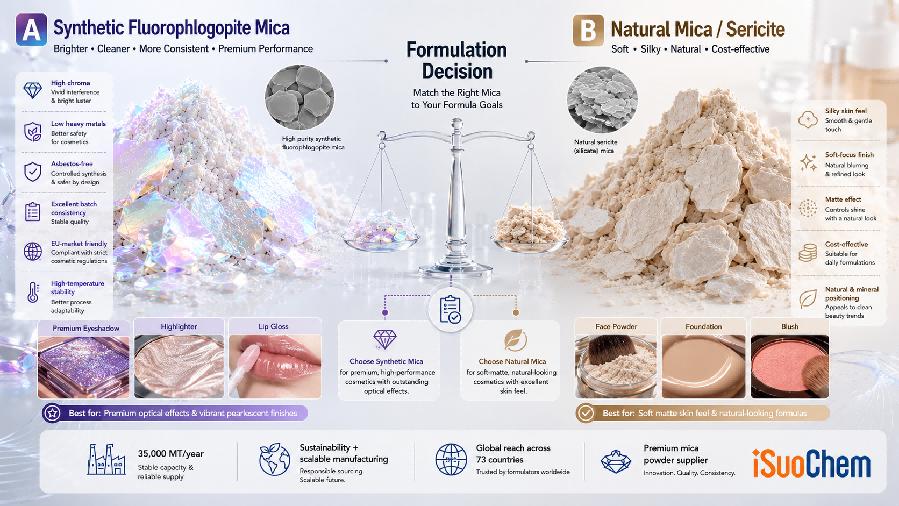
8. Decision Framework: Which Should You Choose?
|
Your Priority
|
Choose This
|
|
Premium optical performance, such as duochrome and high chroma
|
Synthetic mica
|
|
Natural or mineral brand positioning
|
Natural mica
|
|
EU market and CSDDD due diligence compliance
|
Synthetic mica, with no mining-origin risk
|
|
Cost-sensitive mass market
|
Natural mica
|
|
High-temperature processing above 300°C
|
Synthetic mica, mandatory
|
|
Soft-focus, matte skin finish
|
Natural sericite
|
|
Maximum batch-to-batch consistency
|
Synthetic mica
|
Hybrid approach: Several premium cosmetic brands use synthetic mica for effect pigments, such as eyeshadow and highlighter, and natural sericite as the bulk filler in face powders. This balances optical performance with the tactile signature of natural mica.
FAQ: Synthetic vs. Natural Mica for Cosmetics
Q1: Is synthetic mica safe for cosmetic use?
According to the U.S. FDA 21 CFR §73.2496 and EU Cosmetics Regulation (EC) No 1223/2009, both natural mica (CI 77019) and synthetic fluorophlogopite are approved color additives for cosmetic use. Synthetic mica typically has lower trace heavy metal content due to its controlled production process.
Q2: Can I directly substitute synthetic mica for natural mica in an existing formula?
Not without testing. The INCI names are different, so a label change is required. The sensory profile differs, synthetic feels more gliding while natural feels silkier, and the optical behavior in pearlescent pigments changes. Reformulation and stability testing are recommended when switching substrates.
Q3: Why do synthetic mica pearlescent pigments show more vivid colors?
The lower refractive index of synthetic fluorophlogopite, approximately 1.52–1.55, creates higher optical contrast with the TiO₂ coating layer, with an RI of approximately 2.5–2.7, intensifying interference color saturation. The smoother platelet surface also enables more uniform coating thickness, reducing optical haze.
Q4: Which substrate do premium cosmetic brands prefer in 2026?
According to industry formulation trends and supplier data from Anhui iSuoChem, serving 73+ countries, synthetic mica is increasingly specified for premium eyeshadow, highlighter, and lip products. Natural sericite remains preferred for face powder and foundation where skin feel is the primary differentiator.
Q5: Does synthetic mica have asbestos?
No. Synthetic fluorophlogopite is produced by high-temperature melt crystallization of purified raw materials. Asbestos is a naturally occurring mineral that forms in geological environments. The synthesis process makes asbestos contamination physically impossible.
Q6: Is synthetic mica more expensive than natural mica?
Yes, typically 2–3× the price of natural cosmetic-grade mica. The price gap is narrowing as Chinese synthetic mica production capacity expanded ~40% in 2025. For applications where synthetic mica is mandatory, such as automotive coatings and high-temperature processing, the cost is non-negotiable.
Q7: What is sericite and how is it different from regular mica?
Sericite is a fine-grained variety of muscovite mica with a typical median particle size, or D50, of 5–15 μm. It is the preferred natural mica grade for cosmetics due to its exceptionally silky skin feel and soft-focus optical effect. Coarser natural mica grades are used in industrial coatings and plastics.
Q8: Do I need to change my product label if I switch to synthetic mica?
Yes. Natural mica is listed as Mica (CI 77019) on INCI labels. Synthetic mica is listed as Synthetic Fluorophlogopite. If your current label says “Mica” and you substitute synthetic, the INCI declaration must be updated to remain compliant.
References & Sources
-
U.S. FDA 21 CFR §73.2496: Mica (Color Additive Status) — Government Regulation
-
EU Cosmetics Regulation (EC) No 1223/2009, Annex IV (CI 77019) — Official EU Regulation
-
ASTM D5187-21: Standard Test Method for Asbestos in Talc/Mica — Official Standard
-
Responsible Mica Initiative (RMI): Standard Development Procedure, August 2024 — Industry Initiative
-
Kolortek: “Natural Mica vs Synthetic Mica: Key Differences for Formulators,” April 2026 — Industry Media
-
Alibaba.com: Mica Powder Transaction Data, Q1 2026 — Industry Platform Data
-
China Synthetic Mica Industry Association: 2025 Capacity Report — Industry Data
Keywords: synthetic mica powder, natural mica powder, mica powder for cosmetics, synthetic fluorophlogopite, mica powder comparison, mica powder vs synthetic, mica powder FDA, Anhui iSuo mica powder


 web@ispigment.com
 +86 13965049124
 English
  français
 русский
 italiano
 español
 português
 العربية
 한국의
한국의 ไทย
ไทย Tiếng Việt