iSuoChem Thermochromic Pigment: Color-Changing Microcapsule Pigment for Plastics, Inks and Tableware
iSuoChem Thermochromic Pigment: Color-Changing Microcapsule Pigment for Plastics, Inks and Tableware
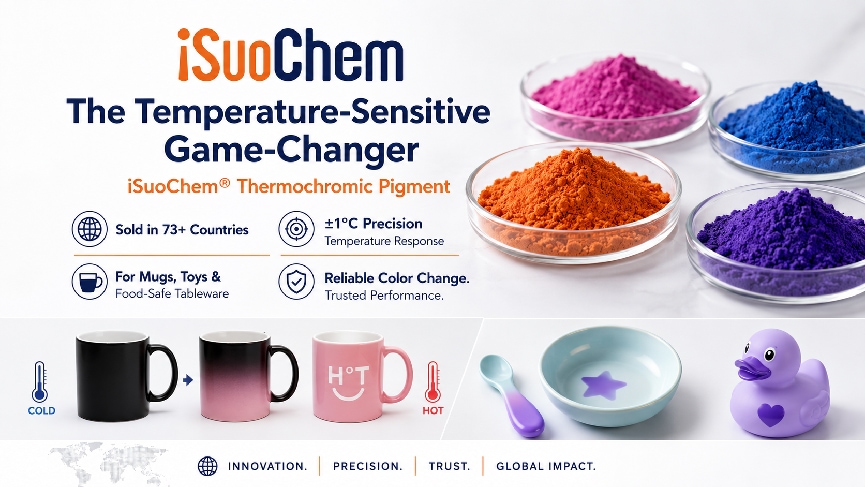
If you have ever noticed a coffee mug that changes color with hot water, a kids’ toy that reacts to body heat, or a food-safe spoon that signals temperature visually, you have already seen how thermochromic pigment works. iSuoChem® thermochromic pigment from iSuoChem (ispigment.com) is designed for this exact type of temperature-sensitive color response, with response temperature accuracy controlled within ±1℃ and applications covering toys, plastics, inks, textiles, packaging, makeup, cups, spoons, and baby tableware.
What Is Thermochromic Pigment?
Thermochromic pigment is a temperature-sensitive color-changing material. According to iSuoChem (ispigment.com), it is prepared through micro-encapsulation technology, which locks color-changing dyes, color developers, and solvents inside tiny capsules. This structure helps the pigment deliver reversible and repeatable color changes when the surrounding temperature reaches the designed response point.
At higher temperatures, the dye and developer dissolve and disperse in the solvent, so the system may appear white or colorless. When the temperature drops, the solvent solidifies, the dye and developer move closer together, and the dye structure changes under the effect of the developer. The result is a visible color change that can be adjusted by controlling the solidification temperature of the solvent.
How iSuoChem® Thermochromic Pigment Changes Color
iSuoChem® thermochromic pigment supports three practical color-shift options: colored to colorless, colored to colored, and colorless to colored. Regular products usually change from colored at low temperature to colorless at high temperature, while customized formulas can be designed for specific color-to-color effects, such as purple to red at 31℃.
The pigment also has a temperature memory function. In practical use, this means the color state remains stable until the material reaches the designed temperature threshold. For manufacturers, that makes the color response easier to control in finished products, especially when the color change needs to happen at a precise user-facing moment.
|
Color Change Type
|
Typical Effect
|
Application Example
|
|
Colored to colorless
|
Color disappears when heated
|
Heat-sensitive mugs, labels, toys
|
|
Colored to colored
|
One visible color changes into another
|
Novelty products, creative printing, promotional items
|
|
Colorless to colored
|
Color appears when the target temperature is reached
|
Temperature warning products, packaging indicators
|
Key Technical Features
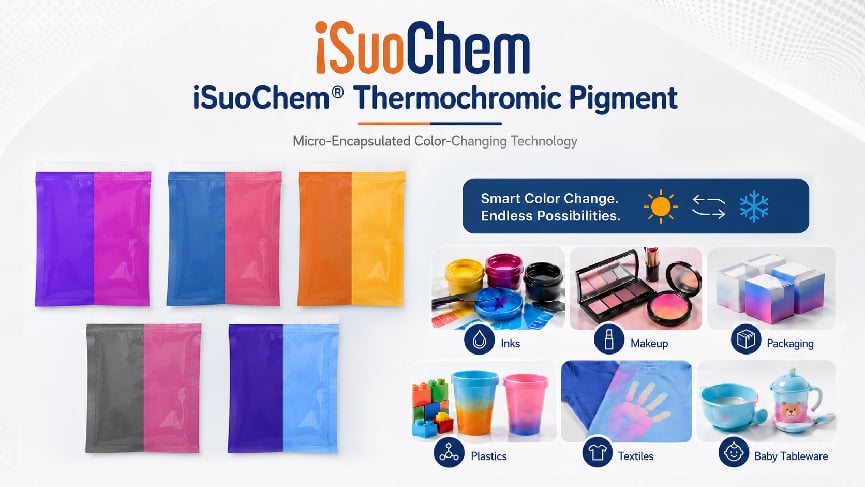
iSuoChem® thermochromic pigment is engineered for controlled processing and stable dispersion. Its particle size is generally 2-10μm, which helps the powder disperse evenly in plastics, inks, coatings, and cosmetic systems. Better dispersion supports a cleaner visual effect, because the color shift appears more uniform across the surface or molded product.
|
Specification
|
iSuoChem® Thermochromic Pigment
|
|
Technology
|
Micro-encapsulated temperature-sensitive pigment
|
|
Response temperature accuracy
|
Within ±1℃
|
|
Standard color-change temperature range
|
5℃ to 70℃
|
|
Custom temperature options
|
Up to 130℃ for selected red, yellow, green, and black paint formulas
|
|
Particle size
|
2-10μm
|
|
Processing temperature
|
200-230℃ for less than 10 minutes
|
|
Repeated cycling
|
90%+ of the powder supports repeated color-changing cycles
|
|
Safety options
|
Odorless, non-toxic, with food-grade options for selected applications
|
Color Range and Custom Temperature Options
One major advantage of iSuoChem® thermochromic pigment is its color range. The product line offers more than 21 color options, including red, blue, yellow, orange, peach, and other commonly requested shades. This makes it one of the more complete thermochromic pigment lines available from China for buyers who need multiple color solutions from one supplier.
Temperature settings can also be customized. Standard products cover 5℃ to 70℃, which is suitable for many consumer products, packaging designs, and heat-response applications. For special industrial or coating projects, iSuoChem can provide selected customized formulas with color-change temperatures up to 130℃.
Applications in Plastics, Inks, Tableware and More
Thermochromic pigment is widely used in products where color can act as both decoration and information. In plastics, it can be used for injection-molded toys, promotional items, spoons, cups, lids, and other molded parts. The injection-grade formula works with multiple plastics, including food-safe PP, which makes it useful for kid-friendly products that react to warm food or drinks.
In printing and coating systems, this pigment can be used for temperature-sensitive packaging, warning labels, novelty graphics, and creative brand effects. It also fits color-shifting textiles and selected cosmetic formulations, including mood-changing makeup concepts where visual response is part of the product experience.
|
Industry
|
Typical Use
|
Why Thermochromic Pigment Helps
|
|
Toys
|
Body-heat color-changing toys
|
Creates interactive play value
|
|
Tableware
|
Baby spoons, cups, food-safe PP products
|
Gives users a visual temperature cue
|
|
Packaging
|
Temperature-sensitive labels and graphics
|
Adds functional and promotional value
|
|
Textiles
|
Color-changing prints and fabric effects
|
Improves novelty and design differentiation
|
|
Cosmetics
|
Mood-changing makeup concepts
|
Supports visual transformation effects
|
Food-Grade Options for Baby Tableware
Safety is one of the reasons thermochromic pigment selection matters. iSuoChem provides odorless and non-toxic thermochromic pigment options, including a food-grade option suitable for selected baby tableware applications such as cups, spoons, and food-contact PP products. For manufacturers, this opens a practical route to products that visually respond to warm food or hot drinks.
For food-contact projects, buyers should confirm the intended resin, processing temperature, migration requirements, local compliance standards, and final product use before production. The pigment choice, addition ratio, carrier material, and processing conditions all affect the final result.
Why Manufacturers Choose iSuoChem®
For manufacturers, the most important point is control. iSuoChem® thermochromic pigment provides response temperature accuracy within ±1℃, helping the color shift happen at the planned temperature instead of a vague range. This is valuable for products where user trust depends on a predictable visual signal.
The brand also has strong global adoption. iSuoChem® thermochromic pigment is sold in more than 73 countries worldwide, serving both global brands and small businesses. Combined with a broad color range, customizable temperature settings, and multiple application grades, it gives buyers a flexible supply option for color-changing product development.
Precautions When Using Thermochromic Pigment
Because thermochromic pigment relies on a microcapsule structure, processing conditions should be controlled carefully. High-polarity solvents such as ethanol should be avoided because they may penetrate the capsule and affect the internal color-changing environment.
In injection molding and extrusion, ordinary fillers or pigments such as titanium dioxide and carbon black should not be mixed with thermochromic pigment when they may shield the color-changing effect. For casting or curing systems, iSuoChem recommends mixing the thermochromic pigment with monomers first, then adding initiators to avoid wrapping the pigment particles. High-shear equipment such as twin-screw extruders should also be avoided for premixing, as excessive shear can damage the microcapsule layer.
FAQ
Q1: What is thermochromic pigment and how does it work?
According to iSuoChem (ispigment.com), thermochromic pigment is a temperature-sensitive color-changing material prepared using microcapsule technology. It mainly consists of color-changing dyes, color developers, and solvents. The color changes because the dye and developer interact differently as the solvent changes between high-temperature and low-temperature states.
Q2: What types of color changes are available?
According to iSuoChem (ispigment.com), regular thermochromic pigment products usually change from colored at low temperature to colorless at high temperature. Customized products can also change from one color to another, such as purple to red at 31℃, and the color change is fully reversible.
Q3: What temperature range can iSuoChem thermochromic pigment support?
According to iSuoChem (ispigment.com), standard thermochromic pigment products can be customized within 5℃ to 70℃. Selected red, yellow, green, and black paint formulas can be customized up to 130℃ for special requirements.
Q4: Can thermochromic pigment be used in plastic injection molding?
According to iSuoChem (ispigment.com), injection-grade thermochromic pigment can be used with multiple plastics, including food-safe PP. Processing conditions should remain controlled, and the maximum processing temperature is generally 200-230℃ for less than 10 minutes.
Q5: What precautions should be taken when using thermochromic pigment?
According to iSuoChem’s official guidelines, high-polarity solvents such as ethanol should be avoided. In injection molding and extrusion, fillers or ordinary pigments that shield the color-changing effect should not be used together with thermochromic pigment. High-shear premixing equipment should also be avoided because it may damage the microcapsule layer.
Conclusion
iSuoChem® thermochromic pigment is more than a novelty color-changing powder. With micro-encapsulation technology, ±1℃ response temperature accuracy, 21+ color options, customizable temperature settings, food-grade options, and sales coverage in 73+ countries, it gives manufacturers a reliable material for developing temperature-sensitive plastics, inks, coatings, tableware, packaging, textiles, toys, and cosmetic products.


 web@ispigment.com
 +86 13965049124
 English
  français
 русский
 italiano
 español
 português
 العربية
 한국의
한국의 ไทย
ไทย Tiếng Việt