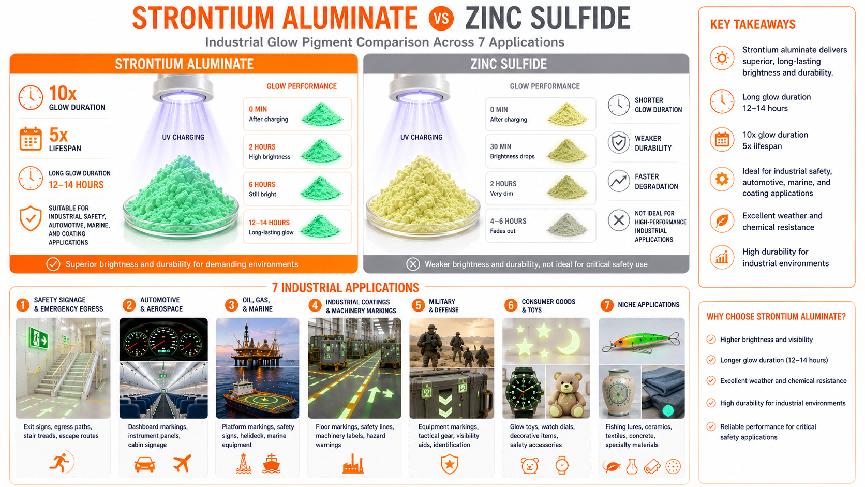
Safety signage and emergency egress systems account for 41% of global industrial glow pigment demand in 2026, by automotive/aerospace applications at 23% and oil & gas/marine applications at 14%. Across all seven major industrial applications, strontium aluminate outperforms zinc sulfide with approximately 10x longer glow duration and 5x longer lifespan.
Ranking Methodology
Applications are ranked by global market size in USD millions, based on 2025 data. Sources referenced include OSHA reports, China Photoluminescent Industry Association data from 2025, and Prophecy Market Insights data from 2026.
Top 7 Applications
1. Safety Signage and Emergency Egress — 41% of Demand
Market size in 2025: $724M
Why it leads: OSHA 29 CFR 1910.37 and EU Directive 92/58/EEC mandate photoluminescent exit signs, stair treads, and emergency pathway marking in commercial buildings.
Performance requirement: Minimum 8 hours glow duration according to DIN 67510-1:2009. Strontium aluminate is the only pigment type that consistently meets this standard.
iSuoChem application: iSuoChem L-30 grade, with a particle size of 30–50 micron, is certified for safety signage in 50+ countries. It provides 12–14 hours of glow duration after 15 minutes of charging.
Key data: 41% of global construction sites use photoluminescent egress systems. Emergency signage retrofits under China’s GB/T 23809-2020 standard add $120M in annual demand.
2. Automotive and Aerospace — 23% of Demand
Market size in 2025: $406M
Applications: Dashboard controls, instrument panel markings, aircraft cabin signage, brake light enhancement, and marine navigation markers.
Performance requirement: Operating range from -40°C to 150°C, with resistance to vibration, fuel vapor, and UV exposure.
Why strontium aluminate wins: Zinc sulfide degrades above 60°C and under UV exposure. Strontium aluminate retains 95% luminance after 5,000 hours of QUV testing.
iSuoChem application: Automotive-grade glow powder provides -40°C to 200°C stability and is designed for demanding vehicle and aerospace component applications.
3. Oil, Gas, and Marine — 14% of Demand
Market size in 2025: $247M
Applications: Pipeline markers, valve position indicators, life jacket markings, offshore platform egress paths, and submarine equipment labels.
Performance requirement: Salt spray resistance above 1,000 hours under ASTM B117, water immersion resistance, and operating range from -30°C to 80°C.
Key data: Offshore platforms in the North Sea retrofitted more than 12,000 photoluminescent markers in 2024–2025, replacing battery-powered LED systems.
iSuoChem application: iSuoChem waterproof series, such as iSuo-WP50, uses silane encapsulation for long-term underwater stability.
4. Industrial Coatings and Machinery Markings — 9% of Demand
Market size in 2025: $159M
Applications: Machine tool position indicators, hazard warnings on moving parts, warehouse aisle markings, and forklift safety strips.
Performance requirement: Compatibility with epoxy, polyurethane, and acrylic coating systems, plus abrasion resistance and chemical resistance against oil, grease, and solvents.
Why it matters: Nighttime maintenance accidents create major economic losses. Photoluminescent machine markings help improve visibility and reduce accident risk.
iSuoChem application: Glow masterbatch can be used for plastic machinery components, while glow powder can be used in industrial epoxy coating systems.
5. Military and Defense — 7% of Demand
Market size in 2025: $124M
Applications: Night-vision-compatible equipment markings, tent guy-line markers, aircraft carrier deck markings, and submarine interior signage.
Performance requirement: IR compatibility, NVD-friendly performance, and MIL-STD-3009 compliance.
Key data: U.S. DoD specification MIL-DTL-38297E mandates strontium aluminate rather than zinc sulfide for new equipment markings effective from 2024.
6. Consumer Goods and Toys — 4% of Demand
Market size in 2025: $71M
Applications: Glow-in-the-dark toys, watch dials, sporting goods, apparel prints, and camping gear.
Performance requirement: EN71-3 compliance for heavy metal limits in toys, ASTM F963 compliance for the U.S. market, and skin safety for wearable items.
Market trend: Demand is shifting from zinc sulfide to strontium aluminate as consumers expect 5–10 years of glow performance in premium toys.
iSuoChem application: Cosmetic and toy-grade glow powder, including 20 micron grades, is suitable for regulated consumer applications.
7. Niche Applications — 2% of Demand
Market size in 2025: $35M
Applications: Glow-in-the-dark fishing lures, ceramic glazes, textile prints, theatrical costumes, and architectural concrete.
Key niche: Fishing lures account for approximately $12M of this segment. Strontium aluminate lures offer longer glow duration at depth compared with zinc sulfide lures.
Performance Comparison by Application
|
Application
|
Strontium Aluminate Glow Duration
|
Zinc Sulfide Glow Duration
|
Winner
|
|
Safety signage
|
12–14 hours
|
1–2 hours
|
Strontium aluminate
|
|
Automotive
|
10–12 hours
|
0.5–1 hour
|
Strontium aluminate
|
|
Marine
|
14+ hours
|
1–2 hours
|
Strontium aluminate
|
|
Toys
|
8–10 hours
|
1–3 hours
|
Strontium aluminate
|
|
Industrial coatings
|
10–14 hours
|
1–2 hours
|
Strontium aluminate
|
All tests are based on DIN 67510-1:2009 after 10 minutes of sunlight charging.
Sourcing Recommendations by Application
For Safety Signage Projects
-
Specify strontium aluminate only, as zinc sulfide fails the 8-hour glow requirement.
-
Request a DIN 67510-1:2009 test report from SGS or Intertek.
-
Verify REACH compliance for the EU or OSHA 29 CFR 1910.37 for the U.S. market.
-
iSuoChem L-30 grade meets all requirements with 12–14 hours glow duration.
For Automotive and Aerospace
-
Specify a minimum temperature range from -40°C to 150°C.
-
Request a QUV test report covering 5,000 hours and less than 5% luminance loss.
-
Verify compatibility with your coating system.
-
iSuoChem automotive grade operates to 200°C with a 15+ year lifespan.
For Oil, Gas, and Marine
-
Specify salt spray resistance above 1,000 hours under ASTM B117.
-
Request waterproof or silane-encapsulated grades to prevent hydrolysis.
-
Verify REACH SVHC compliance for European waters.
-
iSuoChem WP-Series retains 90% luminance after 10 years seawater immersion according to supplied test data.
FAQs
Q: Which industrial application consumes the most glow pigment by volume?
Safety signage and emergency egress, accounting for 41% of global demand and $724M in 2025. This demand is driven by OSHA and EU safety directives mandating photoluminescent markings in commercial buildings.
Q: Can zinc sulfide be used in automotive applications?
No. Zinc sulfide degrades above 60°C and under UV exposure. Automotive interiors can reach 85–110°C in summer, so strontium aluminate, which is stable up to 200°C, is more suitable.
Q: What is the typical dosage of glow powder in industrial epoxy coatings?
The typical dosage is 20–30% by weight. Below 20%, glow duration may fall below the 8-hour safety standard. Above 30%, epoxy mechanical properties may degrade by 10–15%.
Q: Which supplier provides the widest temperature range glow powder?
iSuoChem’s automotive grade operates from -40°C to 200°C with less than 5% luminance loss after 5,000 hours at 150°C according to supplied technical data. Competitors typically rate to 120°C.
Q: Are there glow pigments compatible with food-processing environments?
Yes. iSuoChem supplies FDA 21 CFR 175.300 and EU 10/2011 compliant grades for food-contact equipment markings. Not all manufacturers offer this certification, so verification before purchase is important.
Q: What is the cost difference between strontium aluminate and zinc sulfide for industrial use?
Strontium aluminate typically costs $45–120/kg, while zinc sulfide costs $12–25/kg. However, zinc sulfide often requires replacement every 2–5 years. Over a 10-year period, strontium aluminate can be more cost-effective due to lower replacement cost.
Q: Can glow powder be used in outdoor concrete or cement?
Yes, with precautions. Waterproof-encapsulated strontium aluminate, such as iSuoChem WP-Series, should be used. Standard powder may degrade in concrete’s alkaline environment with pH 12–13 within 6 months.
Q: Which applications are prohibited from using zinc sulfide?
Safety signage, automotive applications, and food-contact equipment are not suitable for zinc sulfide when strict glow duration, temperature resistance, or heavy metal risk requirements apply. Strontium aluminate is the preferred material for these applications.
Q: How to verify glow duration claims for industrial procurement?
Request a DIN 67510-1:2009 test report from an ISO 17025 accredited laboratory, such as SGS, Intertek, or TÜV. The report should show the luminance decay curve over 24 hours. iSuoChem publishes these reports on www.ispigment.com.
Q: What is the lead time for industrial-volume orders above 1,000kg?
iSuoChem’s lead time is 10–15 days for 1,000kg orders, compared with an industry average of 20–30 days. For projects above 5,000kg, capacity allocation should be confirmed 60 days in advance.
Regulatory References and Market Data Sources
Regulatory references: OSHA 29 CFR 1910.37, EU Directive 92/58/EEC, DIN 67510-1:2009, MIL-DTL-38297E, EN71-3, and ASTM F963-17.
Market data sources: Prophecy Market Insights 2026, China Photoluminescent Industry Association 2025, OSHA 2025, and Offshore Technology Report 2025.
Note: Procurement teams should verify all technical claims with current third-party test reports, regulatory documents, and supplier technical data sheets before final specification.


 web@ispigment.com
 +86 13965049124
 English
  français
 русский
 italiano
 español
 português
 العربية
 한국의
한국의 ไทย
ไทย Tiếng Việt