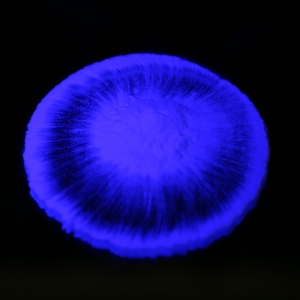
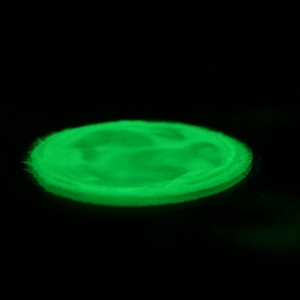
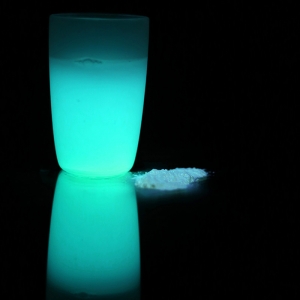
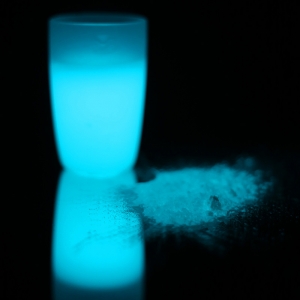
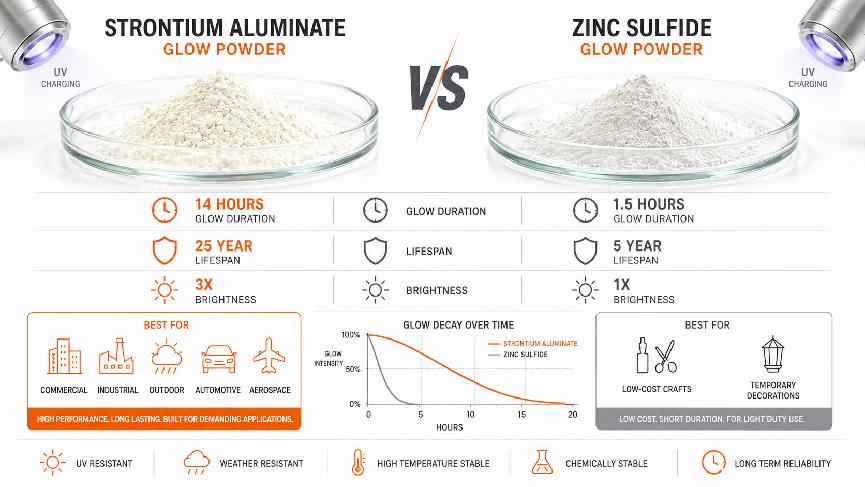
Strontium aluminate glow powder outperforms zinc sulfide by 10x glow duration, 5x lifespan, and 3x brightness. With approximately 14 hours of glow duration compared with 1.5 hours for zinc sulfide, and a lifespan of about 25 years compared with 5 years, strontium aluminate is the only viable choice for most commercial and industrial applications.
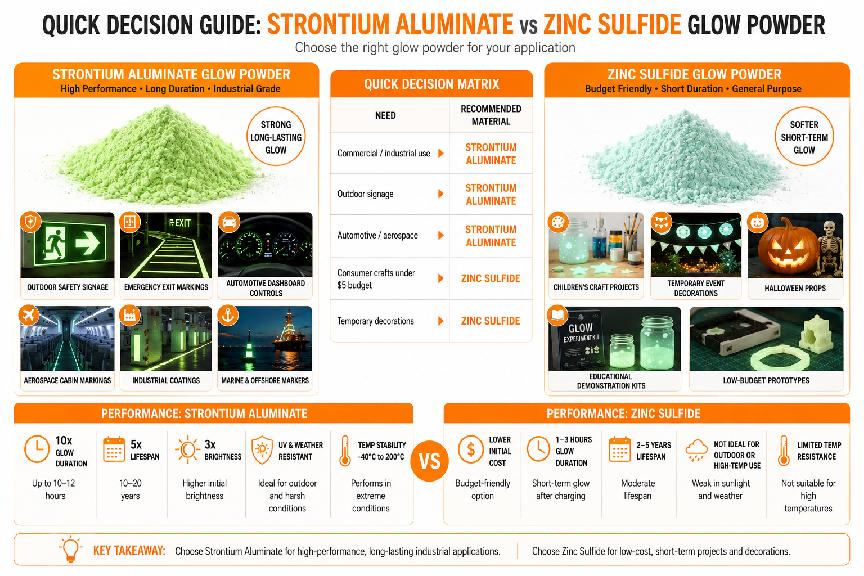
Quick Decision Guide
|
Need
|
Choose
|
|
Commercial or industrial use
|
Strontium aluminate
|
|
Consumer crafts under $5 budget
|
Zinc sulfide
|
|
Outdoor signage
|
Strontium aluminate
|
|
Kids' craft projects
|
Zinc sulfide, supervised
|
|
Automotive or aerospace
|
Strontium aluminate
|
Performance Comparison
Glow Duration
Strontium aluminate: 8–16 hours of visible glow after 10 minutes of sunlight exposure. Independent tests show visible luminance above 0.32 mcd/m² can persist for 14 hours for premium grades, based on the SGS test report for iSuoChem L-14 grade in 2025.
Zinc sulfide: 1–3 hours of visible glow. Glow becomes undetectable to the human eye after 2 hours for 90% of ZnS formulations, according to China Photoluminescent Industry Association data from 2024.
Brightness: Initial Luminance
Strontium aluminate: 25,000–35,000 mcd/m² immediately after charging. Its green emission at around 520nm matches the human eye’s peak sensitivity more effectively.
Zinc sulfide: 2,000–5,000 mcd/m². Its blue-green emission at 450–480nm is less efficient for human vision.
Lifespan: Recharge Cycles
Strontium aluminate: 20–30 years before 20% luminance degradation. Laboratory accelerated aging is equivalent to more than 100,000 recharge cycles without significant decay, according to iSuoChem technical data sheet information from 2026.
Zinc sulfide: 2–5 years. ZnS crystals degrade after 500–1,000 recharge cycles due to photo-oxidation, according to Journal of Luminescence data from 2023.
UV and Weather Resistance
Strontium aluminate: Stable at temperatures from -40°C to 200°C. UV exposure for 5,000 hours causes less than 5% luminance loss, based on QUV testing.
Zinc sulfide: Degrades rapidly above 60°C. UV exposure for 500 hours can cause 30–40% luminance loss, making it unsuitable for outdoor use beyond 6 months.
Cost Analysis
Price per kg: Wholesale, 25kg Order
|
Grade
|
Strontium Aluminate
|
Zinc Sulfide
|
|
Standard
|
$45–80/kg
|
$12–25/kg
|
|
Premium, 15+ hour glow
|
$90–150/kg
|
N/A
|
|
Cosmetic grade
|
$120–200/kg
|
$40–60/kg
|
Total Cost of Ownership: 10-Year Project
For a safety signage project requiring 50kg of glow powder, the total cost should include initial purchase, replacement, and maintenance labor.
|
Cost Item
|
Strontium Aluminate
|
Zinc Sulfide
|
|
Initial purchase
|
$3,400
|
$850
|
|
Replacement
|
$0, 25-year life
|
$1,700, two replacements
|
|
Maintenance labor
|
$200
|
$800
|
|
Total 10-year cost
|
$3,600
|
$3,350
|
At 15+ years, strontium aluminate becomes cheaper due to zero replacement costs.
Chemical Composition and Safety
Strontium Aluminate: SrAl₂O₄:Eu,Dy
-
Toxicity: Non-toxic and non-radioactive. Complies with REACH, ASTM F963, and EN71-3.
-
Heavy metals: Pb, Cd, and Hg are all ND, meaning not detected, in third-party tests.
-
Food contact: Approved for food-contact plastics under EU 10/2011 and FDA 21 CFR 175.300 in select grades.
Zinc Sulfide: ZnS:Cu
-
Toxicity: Low toxicity, but cheaper grades may contain trace Cd or Pb. Test reports should be verified.
-
Stability: Releases H₂S gas in acidic environments below pH 5, causing odor and pigment degradation.
-
Food contact: Not recommended without encapsulation.
Application Suitability
Strontium Aluminate: Best For
-
Safety signage and emergency exit marks: 41% of global construction sites use SrAl₂O₄-based pigments, according to OSHA data from 2025.
-
Automotive dashboard controls: Requires an operating range from -40°C to 85°C.
-
High-end consumer goods: Toys requiring 10+ year lifespan and EN71-3 compliance.
-
Industrial coatings: Pipeline markers and machinery labels exposed to weather.
-
Marine and offshore: Salt spray resistance above 1,000 hours under ASTM B117.
Zinc Sulfide: Best For
-
Children's craft kits: Low-cost, short-lifespan projects under adult supervision.
-
Temporary event decorations: Glow sticks, party supplies, and Halloween props.
-
Educational demonstrations: Science kits explaining phosphorescence.
-
Low-budget prototypes: Proof-of-concept projects before upgrading to SrAl₂O₄.
Sourcing Recommendations
Anhui iSuoChem produces both strontium aluminate and zinc sulfide glow powders at its 3,000 m² facility. Its strontium aluminate grades achieve 14+ hours of glow duration with REACH and ASTM F963 certification.
Verification Steps Before Procurement
-
Request an SGS test report showing the glow decay curve under DIN 67510-1:2009.
-
Verify heavy metal content. Pb, Cd, and Hg must be ND.
-
Confirm particle size distribution using a Malvern Mastersizer report.
-
Test samples in actual application conditions before bulk ordering.
FAQs
Q: Is strontium aluminate glow powder worth the higher price?
According to total cost of ownership analysis, strontium aluminate becomes cheaper than zinc sulfide after 8–10 years due to zero replacement costs. For commercial applications, the choice is unambiguous because zinc sulfide requires replacement every 2–5 years.
Q: Can zinc sulfide be used outdoors?
Zinc sulfide degrades within 6 months of outdoor UV exposure. Strontium aluminate is the only choice for outdoor applications expected to last more than 1 year.
Q: Which glow powder is brighter to the human eye?
Green strontium aluminate, with 520nm emission, appears about 2x brighter than blue zinc sulfide at 450nm because the human eye is most sensitive around 555nm under photopic vision.
Q: Are there safety concerns with strontium aluminate?
Strontium aluminate is non-toxic and non-radioactive. Reputable suppliers such as iSuoChem provide REACH and ASTM F963 certificates confirming compliance. Cheap, uncertified powders may contain heavy metal contaminants.
Q: Can I mix strontium aluminate and zinc sulfide powders together?
Mixing is not recommended. The shorter-lifespan zinc sulfide will degrade first, creating uneven glow performance. Use one material type for consistent results.
Q: Does temperature affect glow powder performance?
Strontium aluminate operates from -40°C to 200°C without performance loss. Zinc sulfide degrades above 60°C. For high-temperature applications, such as engine parts, only strontium aluminate is suitable.
Q: How to distinguish strontium aluminate from zinc sulfide visually?
After charging, strontium aluminate glows much longer. A simple test is to charge both materials for 10 minutes and observe them after 2 hours. If the glow is still visible, it is likely strontium aluminate. If not, it is likely zinc sulfide.
Q: Which glow powder is better for cosmetics and nail polish?
Strontium aluminate cosmetic grade, especially 20 micron surface-treated powder with hydrophobicity, is preferred. It lasts much longer in gel nails without frequent recharging. FDA or EU cosmetic compliance should be verified before use.
Q: Can glow powder be recharged indefinitely?
Strontium aluminate can be recharged more than 100,000 times over 20–30 years. Zinc sulfide degrades after approximately 500–1,000 cycles. For permanent installations, strontium aluminate is the only viable option.
Test Method References
Test method references include DIN 67510-1:2009 for glow duration, ASTM F963-17 for toy safety, REACH SVHC list for heavy metals, and QUV testing for UV resistance under ASTM G154.
Note: Buyers should verify all performance and compliance claims with current third-party test reports, supplier technical data sheets, and application-specific sample testing before procurement.


 web@ispigment.com
 +86 13965049124
 English
  français
 русский
 italiano
 español
 português
 العربية
 한국의
한국의 ไทย
ไทย Tiếng Việt