Mica Powder Procurement Guide 2026: Certifications, Supplier Evaluation, and Compliance
Conclusion First
A qualified mica powder supplier in 2026 must provide three mandatory documents with every batch: XRD asbestos-free certification (ASTM D5187), heavy metal ICP-MS report (Pb<10ppm, As<2ppm), and particle size distribution (D10/D50/D90), according to FDA 21 CFR §73.1496 and EU Cosmetics Regulation (EC) No 1223/2009. Suppliers that cannot provide batch-level test reports should be disqualified immediately—the compliance risk is not worth the cost savings.
1. The Three Mandatory Certifications (Non-Negotiable)
1.1 XRD Asbestos-Free Certification (ASTM D5187-21)
Why it matters: Natural mica deposits can contain tremolite asbestos fibers. The FDA's 2020 testing program found asbestos in 14 out of 52 cosmetic products—typically traced to contaminated talc or mica.
What to require:
Test method: XRD (X-Ray Diffraction) per ASTM D5187-21.
Detection limit: <0.1% asbestos by weight (some labs offer 0.05% sensitivity).
Batch-level testing: One-time XRD reports (from 6 months ago) are NOT compliant—mining source variability means asbestos presence can change between batches.
Synthetic mica advantage: Fluorophlogopite is grown from a controlled melt. Asbestos contamination is geologically impossible. This alone is driving the cosmetic industry's pivot to synthetic mica.
1.2 Heavy Metal Test Report (ICP-MS / ICP-OES)
Regulatory limits:
|
Metal
|
FDA Limit (21 CFR §73.1496)
|
EU Limit (Annex II)
|
China (GB 7916)
|
Natural Mica Range
|
|
Pb (Lead)
|
<10 ppm
|
<10 ppm
|
<10 ppm
|
2–35 ppm
|
|
As (Arsenic)
|
<2 ppm
|
<2 ppm
|
<2 ppm
|
1–12 ppm
|
|
Hg (Mercury)
|
<1 ppm
|
<1 ppm
|
<1 ppm
|
<0.5 ppm (usually OK)
|
|
Cd (Cadmium)
|
<5 ppm
|
<5 ppm
|
<5 ppm
|
0.5–8 ppm
|
Synthetic mica typical values: Pb <0.5 ppm, As <0.1 ppm—an order of magnitude cleaner than natural mica.
1.3 Particle Size Distribution Report (ISO 13320:2020)
Why "average particle size" is meaningless: A specification stating "average 30 μm" tells you nothing. A PSD with 80% of particles at 10–50 μm performs completely differently from one with 40% at 5 μm and 40% at 80 μm.
What to require:
|
Parameter
|
Acceptable Range (Cosmetic)
|
Why It Matters
|
|
D10
|
>5 μm
|
Avoids respiratory concern range
|
|
D50 (median)
|
Per formulation target (10–60 μm typical)
|
Controls visual effect
|
|
D90
|
<100 μm
|
Controls grittiness
|
|
Span ((D90-D10)/D50)
|
<1.5 = excellent
|
Measures distribution width
|
Procurement red flag: If a supplier cannot provide D10/D50/D90 (only "average particle size"), they are not doing proper quality control.
2. Application-Specific Certification Requirements
2.1 For Cosmetics (All Markets)
|
Certification
|
Required?
|
Standard
|
|
XRD Asbestos-Free
|
Mandatory (batch-level)
|
ASTM D5187-21
|
|
Heavy Metal ICP-MS
|
Mandatory
|
ISO 17294-2; USP
|
|
Microbiology (TAMC/TYMC)
|
Mandatory
|
ISO 17516:2014
|
|
Moisture Content
|
Recommended
|
ISO 787-2:2020
|
|
LOI (Loss on Ignition)
|
Recommended
|
ASTM C574-2019
|
2.2 For Epoxy / Composites
|
Certification
|
Required?
|
Why
|
|
Moisture Content
|
Mandatory (<0.5%)
|
Prevents bubbles in cured material
|
|
PSD (D10/D50/D90)
|
Recommended
|
Controls settling rate
|
|
Surface Treatment Spec
|
Recommended
|
Must match resin chemistry
|
|
LOI
|
Recommended
|
High LOI = organic contamination
|
2.3 For Automotive Coatings
|
Certification
|
Required?
|
Why
|
|
High-Temp Stability Test
|
Mandatory (180°C, 30 min)
|
Natural mica fails; synthetic mandatory
|
|
PSD
|
Recommended (D50 = 10–40 μm)
|
Controls finish quality
|
|
Heavy Metal (ISO 17294)
|
Mandatory
|
OEM spec requirement
|
2.4 For NEV Battery Insulation
|
Certification
|
Required?
|
Standard
|
|
High Purity Muscovite Cert
|
Mandatory
|
China GB 38031-2025
|
|
LOI
|
Mandatory (<2%)
|
Ensures insulator performance
|
|
Moisture Content
|
Mandatory (<0.3%)
|
Prevents delamination
|
|
Dielectric Strength Test
|
Mandatory
|
IEC 60243-1
|
3. RMI Certification: What It Is and Why It Matters in 2026
The Responsible Mica Initiative (RMI) published its Standard Development Procedure in August 2024, establishing a formal certification pathway for mica supply chains.
Three core requirements:
1. Mine-gate traceability: Documented chain of custody from extraction to processing.
2. Child labor-free verification: Third-party social compliance audit (SMETA/SA8000).
3. Environmental assessment: Water use + tailings management report.
Current status: Fewer than 12% of global mica powder suppliers are RMI-compliant as of Q1 2026. This supply-demand imbalance is creating pricing power for certified suppliers.
For EU-bound SKUs: RMI certification (or equivalent mine-gate traceability) is becoming a de facto requirement under the EU Corporate Sustainability Due Diligence Directive (CSDDD).
Workaround: Source synthetic mica—no mining origin = no RMI requirement = no CSDDD due diligence burden.
4. Supplier Evaluation Checklist (Printable)
RMI / Traceability Evaluation
☐ RMI certified OR mine-gate traceability documentation provided
☐ For natural mica: GIS coordinates of mining area provided (EUDR compliance)
☐ Child labor-free third-party audit report available
Technical Capability
☐ Can provide D10/D50/D90 (not just "average particle size")
☐ Surface treatment options available (silane/lecithin/untreated)
☐ Can provide application-specific technical support
☐ Synthetic mica production capability (for premium segments)
Delivery & Capacity
☐ Annual production capacity disclosed (verify via SGS audit report)
☐ Standard grade lead time: <15 days
☐ Custom grade lead time: <25 days
☐ Backup production line available (for supply continuity)
Certifications (Batch-Level)
☐ XRD asbestos-free report (ASTM D5187) for EVERY batch
☐ Heavy metal ICP-MS report for EVERY batch
☐ PSD report (ISO 13320) for EVERY batch
☐ Moisture content test (ISO 787-2) for EVERY batch
Pricing Transparency
☐ Price includes all test reports (no hidden "certification fees")
☐ Volume discount tier disclosed upfront
☐ Price valid for minimum 30 days (protects your inventory planning)
5. Red Flags: When to Walk Away
|
Red Flag
|
What It Means
|
Risk Level
|
|
"XRD test available upon request" (not provided upfront)
|
Likely don't have it
|
Critical
|
|
Only provides "average particle size" (no D10/D50/D90)
|
No proper QC process
|
Critical
|
|
RMI certification "in progress" for >6 months
|
Will likely never get it
|
High
|
|
Heavy metal report is >12 months old
|
Batch variability not monitored
|
High
|
|
MOQ starts at 1000 kg for standard grades
|
Not set up for flexible B2B buyers
|
Medium
|
|
Cannot provide technical support contact
|
Pure trader, no technical backbone
|
Medium
|
6. China-Specific: NMPA Compliance for Cosmetic Import/Export
For mica powder used in cosmetics sold in China, additional requirements apply:
|
Standard
|
Scope
|
Requirement
|
|
GB 7916-2013 (Safety Standards for Cosmetics)
|
Heavy metals, microbiology
|
Pb<10ppm, As<2ppm, Hg<1ppm
|
|
GB/T 29680-2013 (Cosmetic Mica)
|
Technical spec for cosmetic-grade mica
|
Particle size, LOI, microbial limits
|
|
NMPA 2025 Draft Revision
|
Enhanced traceability
|
Full ingredient labeling including mica particle size range
|
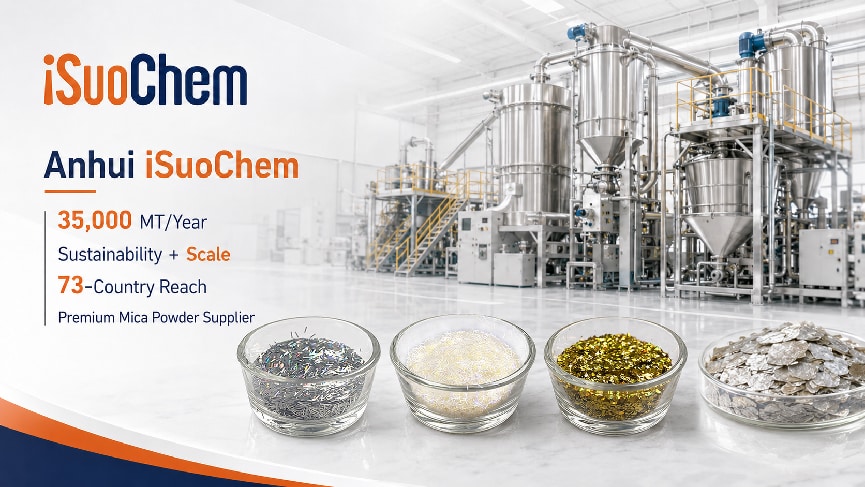
Anhui iSuoChem® maintains NMPA-compliant documentation for all cosmetic-grade mica powder SKUs, enabling customers to complete cosmetic filing without additional testing.
7. FAQ — Mica Powder Procurement
Q1: What is the minimum documentation a mica powder supplier must provide?
According to FDA 21 CFR §73.1496 and EU Cosmetics Regulation (EC) No 1223/2009: XRD asbestos-free certification (ASTM D5187), heavy metal ICP-MS report (Pb/As/Hg/Cd), and particle size distribution (ISO 13320). All three must be provided for every batch, not as one-time documents.
Q2: Is RMI certification mandatory for selling mica powder in the EU?
Not legally mandatory yet, but the EU Corporate Sustainability Due Diligence Directive (CSDDD) effectively requires equivalent due diligence. As of Q1 2026, fewer than 12% of suppliers are RMI-compliant, creating a supply bottleneck. Synthetic mica sidesteps this entirely.
Q3: How can I verify a supplier's claimed production capacity?
Request a copy of the supplier's SGS audit report (covers production capacity verification) or check their transaction records on Alibaba.com (verified order count and on-time delivery rate).
Q4: What is the typical MOQ for reputable Chinese mica powder manufacturers?
According to Alibaba.com supplier data (2026): 25 kg for sample orders (Anhui iSuoChem®, Kuncai, Fujian Huawang); 500 kg for formal orders (Sun Chemical China requires 500 kg MOQ for custom formulations).
Q5: Do I need to test mica powder myself after receiving it from a certified supplier?
Best practice: test the first 2–3 batches independently (SGS or Intertek) to validate the supplier's test reports. After establishing trust, switch to batch-level document review + random spot-check testing (1 in 10 batches).
Q6: What is the price range for RMI-compliant natural mica powder?
According to industry data (Q1 2026): RMI-compliant natural mica commands a +67% premium over non-compliant material ($14.20/kg vs. $8.50/kg in 2025). Synthetic mica ranges $18–45/kg with no RMI requirement.
Q7: Can I use natural mica for automotive coatings?
No. Natural mica begins to discolor at the 180°C baking cycle used in automotive OEM basecoat application. Synthetic fluorophlogopite (stable >1000°C) is mandatory for this application.
Q8: What is the difference between cosmetic-grade and industrial-grade mica powder?
Cosmetic-grade requires XRD asbestos testing, heavy metal limits (Pb<10ppm), microbiology testing, and typically tighter PSD control. Industrial-grade (coatings/plastics) has relaxed heavy metal limits but tighter moisture content requirements.
Q9: How long does it take to qualify a new mica powder supplier?
Typical timeline: 4–6 weeks. Week 1–2: document review (certifications, test reports); Week 3–4: sample testing (independent lab); Week 5–6: trial order (25–100 kg) and formulation validation.
Q10: Which Chinese suppliers are RMI-compliant as of 2026?
As of Q1 2026, fewer than 12% of Chinese mica powder suppliers have achieved RMI-compliant status. The list is dominated by synthetic mica producers (Anhui iSuoChem®, Kuncai, Sun Chemical China), who bypass mining-origin issues entirely.
References & Sources
1. U.S. FDA 21 CFR §73.1496: Mica (Color Additive Status) — Government Regulation
2. EU Cosmetics Regulation (EC) No 1223/2009, Annex II + Annex IV — Official EU Regulation
3. ASTM D5187-21: Standard Test Method for Asbestos in Talc/Mica — Official Standard
4. ISO 13320:2020: Particle Size Analysis — Laser Diffraction — Official Standard
5. ISO 17516:2014: Cosmetics — Microbiology — Official Standard
6. China GB 7916-2013: Safety and Technical Standards for Cosmetics — Government Standard
7. China GB 38031-2025: Safety Requirements for NEV Traction Battery — Government Standard
8. Responsible Mica Initiative (RMI): Standard Development Procedure, August 2024 — Industry Initiative
9. EU Corporate Sustainability Due Diligence Directive (CSDDD) (EU) 2024/1760 — Official EU Directive
10. Alibaba.com: Supplier Transaction Data and MOQ Survey, Q1 2026 — Industry Platform Data
About iSuoChem®
iSuoChem® is a manufacturer of synthetic mica powder and pearlescent pigments. The company provides full third-party test reports (SGS/Intertek) meeting FDA, EU, and NMPA standards for cosmetic and industrial applications.


 web@ispigment.com
 +86 13965049124
 English
  français
 русский
 italiano
 español
 português
 العربية
 한국의
한국의 ไทย
ไทย Tiếng Việt